Southeast Arkansas

Solar Installation in Pine Bluff and the Southeast Arkansas Delta

Delta Solar works with farms, industrial sites, businesses, and homeowners across Pine Bluff, Jefferson County, and the broader Southeast Arkansas Delta. We size systems around real utility bills, real ground or roof conditions, and a service plan that holds up long after the meter is set.

(501) 683-8835

Solar in Southeast Arkansas is driven by ag load, industrial demand, and which utility serves the meter.

The Southeast Arkansas Delta runs on rice, soybeans, cotton, and timber, with row-crop farms spread across Jefferson, Lincoln, Drew, Desha, and Arkansas Counties. Those farms run irrigation pumps through the summer, grain dryers in the fall, and shop and storage loads year-round, which creates usage patterns that solar can actually match. The flat Delta ground also makes ground-mount projects practical in ways that hill-country sites in other parts of Arkansas cannot support, and the sun resource across this part of the state is among the strongest you will find in Arkansas.

Pine Bluff itself is a different planning problem than the surrounding fields. Entergy Arkansas serves most of the city and most of Jefferson County, but the cooperatives pick up large stretches of the surrounding rural territory, and industrial sites near the Pine Bluff Arsenal, Highland Pellets, the Tyson footprint, and the Suzano (formerly Evergreen Packaging) paper mill carry their own load shapes. A homeowner in White Hall, a clinic near Jefferson Regional, a UAPB-adjacent rental, and a row-crop farm outside Altheimer can all need solar, but the financial model has to start with the right utility and the right rate schedule before any system size is quoted.

What Southeast Arkansas Solar Buyers Get From Delta Solar

  • USDA REAP grant and loan guarantee experience for eligible farms and rural small businesses across the Southeast Arkansas Delta
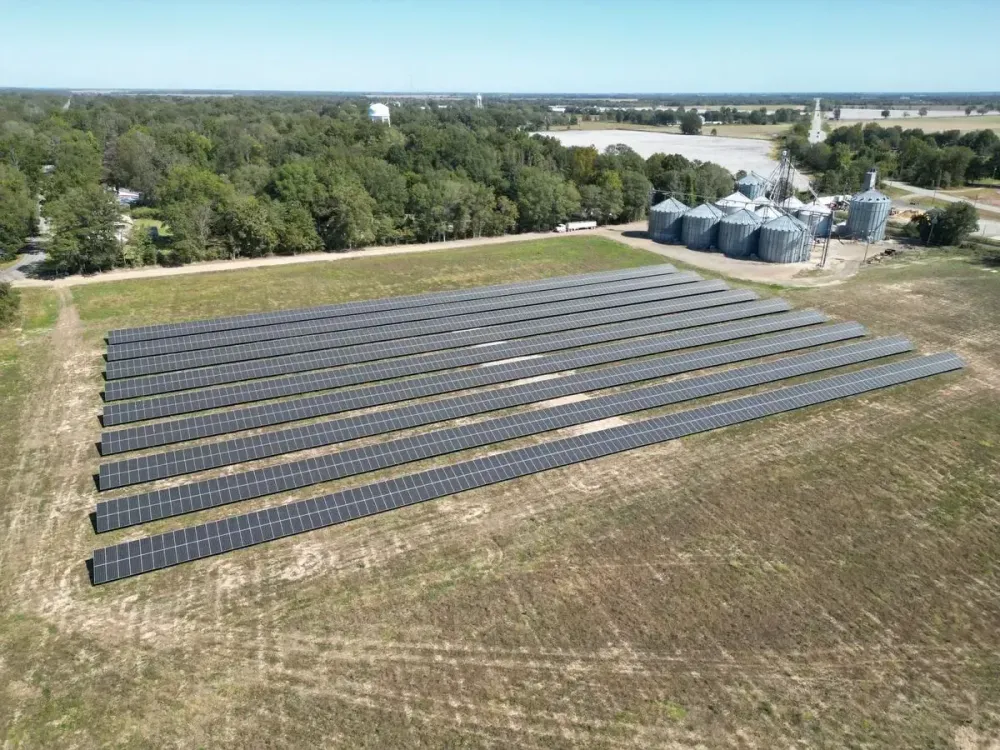
  • Ground-mount system design that takes advantage of flat Delta acreage, with proper drainage, racking, and access planning
  • Bill review built around the specific utility on the meter, including Entergy Arkansas, C&L Electric Cooperative, and First Electric Cooperative
  • Industrial and commercial load modeling for sites tied to the Pine Bluff Arsenal corridor, Highland Pellets, the Suzano paper mill, and the Jefferson Regional medical campus
  • Irrigation and grain-drying load review for row-crop operations where summer pumping or fall drying drives the bill
  • In-house service and monitoring support after the system is energized, with crews that can reach Pine Bluff, White Hall, Stuttgart, Monticello, and Dumas addresses without a third-party call center

Solar in Pine Bluff and Southeast Arkansas: What's Specific

What sets Southeast Arkansas apart is the mix of loads packed into one footprint. Row-crop ground around Altheimer and Wabbaseka pulls irrigation power all summer, grain dryers near the bins run hard in the fall, and the industrial corridor anchored by the Suzano paper mill, Highland Pellets, and the Pine Bluff Arsenal carries heavy daytime demand that does not let up with the seasons. The Delta floor is flat enough that terrain shading is rarely the limiting factor, so the real design question is how a system lines up with the specific load behind the meter. The sun resource here is among the strongest in the state, but tornado and hail exposure is real, so racking, attachment, and grounding all need to be specified for Delta storm conditions rather than copied from a milder site.

Permitting inside the Pine Bluff city limits runs through the City of Pine Bluff Inspection and Zoning Department, with electrical sign-off coordinated through the city. Interconnection then follows whichever utility serves the address: Entergy Arkansas for most accounts in and around the city, and the relevant cooperative for many rural meters. White Hall, Redfield, Stuttgart, Monticello, Dumas, Warren, and Star City each have their own permit offices, and county-level review applies for ground-mount projects outside city limits.

Local Utilities We Work With

  • Entergy Arkansas

    Investor-owned utility serving Pine Bluff and most of Jefferson County, along with large portions of the Southeast Arkansas Delta. Standard Arkansas Public Service Commission interconnection rules apply, and we model net metering against the specific rate schedule on the account before sizing a system.

  • C&L Electric Cooperative

    Member-owned cooperative headquartered in Star City, serving rural portions of Jefferson, Lincoln, Drew, Cleveland, Bradley, Dallas, Desha, and Grant Counties. Co-op interconnection paperwork, rate structure, and net-metering treatment differ from investor-owned utilities and need to be handled on their own terms, especially for ag accounts with irrigation or grain-drying loads.

  • First Electric Cooperative

    Cooperative whose Stuttgart district reaches portions of Jefferson, Arkansas, Lonoke, Monroe, and Prairie Counties. Members should expect a different application process and rate review than Entergy accounts, and we confirm the right paperwork up front before quoting a system.

REAP and farm economics drive a lot of Southeast Arkansas projects.

USDA REAP grants and loan guarantees can meaningfully change the payback on a farm or rural small business solar project, and the Arkansas Delta has been one of the more active regions for these awards in the state. Eligibility, documentation, and timing matter, so we plan REAP-eligible projects around the application window and the actual production a system will deliver on the proposed site rather than the maximum size the budget would allow. Under USDA's new REAP rule, effective October 16, 2026, a project must be built and running for 12 months before it can apply for a grant, grants top out at $500,000 for a renewable energy system, and the owner covers at least 75% of cost. Guaranteed loans are still available for up-front costs on most projects, and we can plan the build so the system is ready to apply once it has a year of data. Our agricultural portfolio includes EG Farms, Isbell Farms, and other Delta operations that have used solar to take direct aim at irrigation, grain-drying, and shop energy costs.

Industrial and ag loads reward ground-mount design.

Rice and soybean operations run irrigation pumps heavily through the summer, grain dryers run hard in the fall, and Pine Bluff's industrial corridor carries steady daytime demand from paper, wood-pellet, food-processing, and federal sites. The flat ground around Pine Bluff, Altheimer, Sherrill, and Wabbaseka makes large ground-mount arrays practical without the slope, shading, and grading work that hill-country sites require. A well-placed ground-mount can sit close enough to the house complex, shop, or pump panel to keep wire runs reasonable and the financial result on track.

Pine Bluff and the SE Delta need service depth as much as new installs.

Southeast Arkansas has a meaningful base of farm and home systems now five to ten years old, and some original installers have closed. Our service team takes those calls regardless of who put the system in, including inverter swaps, monitoring resets, storm-damage checks, and production diagnostics for farm and home accounts. Service capacity is part of the buying decision in this part of the state.

Service Area Across Southeast Arkansas

Delta Solar works with farms, businesses, and homeowners across the Pine Bluff metro and the broader Southeast Arkansas Delta, from the Jefferson County line south through Lincoln and Drew Counties and east toward the Mississippi River.

Pine BluffWhite HallRedfieldAltheimerWabbasekaSherrillTuckerStar CityRisonGradyStuttgartDumasMcGeheeMonticelloWarren
FAQs

Common Questions

Which utility will my Pine Bluff solar project interconnect with?

Most addresses inside Pine Bluff and across Jefferson County are served by Entergy Arkansas, and most projects in the city interconnect under standard Arkansas Public Service Commission rules. Rural meters outside the Entergy footprint are often on C&L Electric Cooperative or, in parts of the county closer to the Stuttgart area, First Electric Cooperative. We confirm the utility on the meter first and model the financial result against that specific rate before recommending a system size.

Can a Southeast Arkansas farm qualify for USDA REAP funding through Delta Solar?

Rice, soybean, and cotton operations across Jefferson, Lincoln, Drew, and Desha Counties are exactly the kind of rural businesses REAP was built for, provided the operation, location, and project details meet USDA requirements. The grant and loan-guarantee side rewards early planning, so we line up the documentation and the production estimate before the application window opens rather than scrambling to fit a project to the program after the fact. Under USDA's new REAP rule, effective October 16, 2026, a project must be built and running for 12 months before it can apply for a grant, grants top out at $500,000 for a renewable energy system, and the owner covers at least 75% of cost. Guaranteed loans are still available for up-front costs on most projects, and we can plan the build so the system is ready to apply once it has a year of data. We are glad to walk a grower through eligibility before any commitment.

Does ground-mount solar make sense on Delta farmland around Pine Bluff?

It often does. Open rice and soybean ground near grain bins and shop complexes can carry an array far larger than any rooftop in the area would hold, and the flat topography keeps grading and racking straightforward. The variables that actually decide a site are drainage during a wet Delta spring, equipment access, and how far the array sits from the load and the meter. We confirm those on the ground with a real site visit before committing to a layout.

Will Delta Solar service a system on a C&L Electric or First Electric meter?

Yes. Our service division works on existing systems across Southeast Arkansas, including farm and residential accounts on the cooperatives. We can review available documentation, inspect the equipment, restore monitoring where possible, coordinate with the cooperative when needed, and recommend practical repairs whether or not we installed the original system.

CallGet Assessment